Tuesday, August 19, 2014

DOCTOR: Practicing on Patients

http://mobile.nytimes.com/blogs/well/2014/08/14/practicing-on-patients-2/
By SANDEEP JAUHAR, M.D


“Who should do this case?” That was the question a senior surgeon posed to me outside a patient’s room in the cardiac care unit. Judging by his expression, he already knew the answer.

The patient had a serious infection that had eroded her heart valve, rendering it “incompetent.” Fluid was filling up in her lungs, making it difficult for her to breathe. A helium-filled balloon pump had been inserted into her aorta, the main artery coming out of the heart, to support her low blood pressure, but her condition was deteriorating.

The senior surgeon explained that the patient had been referred to a young surgeon in his practice who had just graduated a year before. “Ethically, I’m not comfortable with him doing the case,” the senior surgeon said. “This lady’s mortality is already high, probably close to 40 percent. In his hands, it’s even higher.”

The young surgeon was obviously going to have to learn to do such cases, but he wasn’t going to start that day. The patient’s condition was too unstable, and even a small mistake could have had devastating consequences. The senior surgeon obviously appreciated his young colleague’s eagerness in seeking out referrals to build up his practice, but he and I knew that a junior surgeon wasn’t the best man for the job.

Every doctor’s expertise is earned on patients, but unfortunately, there is a learning curve.

How to protect patients while doctors learn is a conundrum faced in all areas of medicine. For example, studies have shown that surgeons’ outcomes improve up to four years after their first hospital appointment. Some have argued that neophyte surgeons during this period should take on only the most straightforward cases. Yet every doctor eventually has to perform a procedure for the first time.

A few weeks ago, a second-year cardiology fellow told me that he had taught a first-year how to pull out a balloon pump. “When we went in the room, the patient said, ‘You’re not learning on me, are you?’ And I had to lie and say: ‘No! He’s done this many times. We’re going to do it together. You get two for the price of one.’ That calmed him down. Then I had to talk the first-year through the entire procedure, pretending like I was explaining it to the patient.”

It isn’t only doctors who face this quandary. Hospitals too have their own learning curves. Medical teams work better together with practice. The first few cases of a new procedure frequently have subpar results.

In the early 1990s, a hospital in England introduced an innovative operation to correct transposition of the great arteries, a congenital heart abnormality in babies. Before this, newborns with this condition were treated with a palliative procedure that had poor long-term outcomes. Children at the hospital ultimately benefited from the innovation, but a heavy price was paid. The death rate for babies in the first few years was several-fold higher than with the palliative procedure. Commenting on the poor outcomes, a pediatric surgeon wrote that it was understood that “there would initially be a period of disappointing results.”

The question of how to innovate without hurting patients comes up in my practice. For example, as a heart-failure specialist, I have long wanted to provide left ventricular assist devices (LVADs) to my terminally ill patients. LVADs, such as the one former Vice President Dick Cheney had, are tiny rotor pumps made of plastic and titanium that piggyback onto the heart, pumping blood directly out of it and into the aorta, which transports it to the rest of the body. Most of my patients who require an LVAD say they would prefer to have it implanted close to home on Long Island rather than at the more established centers in Manhattan.

So a couple of years ago, we started an LVAD program for patients with acute cardiac shock. As the cardiologist on the team, I received two days of classroom instruction. My surgical colleagues additionally received animal training (they implanted the device into a calf).

We have now successfully performed the procedure on several patients. A few months ago, I treated a young man who had had a heart attack. His blood pressure was so low that his kidneys had stopped working. I called one of my surgical colleagues to put in an LVAD. He agreed to do it, but he asked me whether my patient wouldn’t be better off being transferred to a hospital that had more experience. “Do we have the best team in place to manage potential complications?” he asked. If it were your father, he said, what would you want?

And he was right. We have had good results with the few implants we’ve done. However, some centers in Manhattan do more than a hundred a year. Though our surgical teams are excellent, theirs are undoubtedly on a flatter portion of the learning curve.

I often wonder whether certain procedures should be “regionalized.” There is a positive correlation between a hospital’s surgical volume and its surgical mortality. For example, hospitals that do 200 or more coronary bypass operations annually have death rates nearly a third lower than hospitals with lower volumes.

But in American medicine, we believe in democracy. Any hospital can apply to be credentialed in a new procedure as long as it can demonstrate a need in the population it serves.

In the current economic climate, with ever-decreasing profit margins, many hospitals are trying to move into profitable surgical ventures. But we need to be careful. Hospitals have the right to innovate, but adequate protections such as expert supervision need to be put in place so patients are not harmed while doctors and institutions learn on them.

Sandeep Jauhar is a cardiologist and the author of “Intern: A Doctor’s Initiation”and the soon-to-be-published memoir “Doctored: The Disillusionment of an American Physician.”

Sunday, July 13, 2014

Repetition Doesn’t Work: Better Ways to Train Your Memory

Gregory Ferenstein
http://www.thedailybeast.com/articles/2014/07/12/repetition-doesn-t-work-better-ways-to-train-your-memory.html
Gregory Ferenstein


Shutterstock

A team of scientists recently discovered that repetition is a terrible way to memorize information—and their findings highlight much better strategies.
new study published in Learning and Memory found that simple repetition interferes with the ability to learn new information, especially when it is similar to a set of familiar facts. This may mean that memorizing facts about an issue through repetition could interfere with the ability to remember a more nuanced version of the same issue later on.
“Our findings suggest that although the ability to generally recognize something is strengthened with multiple encounters, one’s ability to discriminate among similar items in memory decay,” the study says. “In contrast to past beliefs, repetition may reduce the fidelity of memory representations.”
In study, subjects said a list of objects either one or three times. Later on, in the recall phase, another set of similar objects ("lures") was snuck in. Those who had seen objects multiple times better recalled the original objects but had a harder time distinguishing the lures. In other words, their memories were stronger but less precise. Over the long run, repetition can be a false temptress, making us think we've learning something when we really haven't. 
"On your first reading of something, you extract a lot of understanding. But when you do the second reading, you read with a sense of ‘I know this, I know this,’"explain psychologists Henry Roediger and Mark McDaniel, authors of Make it Stick. "So basically, you’re not processing it deeply, or picking more out of it. Often, the re-reading is cursory—and it’s insidious, because this gives you the illusion that you know the material very well, when in fact there are gaps."
Here are a few tips for better memory:
Pace your studying
Not all repetition is bad. It's more accurate to say that cramming is ineffective. “The better idea is to space repetition. Practice a little bit one day, then put your flashcards away, then take them out the next day, then two days later," explain McDaniel and Roediger.
Mentally testing yourself on materials generally increases recall days later, even if there's no feedback on how well you actually remember the facts. In other words, just going over the material in your head at regular intervals has benefits.
Within academia, there's a raging debate about the optimal spacing between recall intervals [PDF]. One of the original systems, by foreign language learning icon Paul Pimsleur, advocated for a pacing of five seconds, 25 seconds, two minutes, 10 minutes, one hour, five hours, one day, five days, 25 days, four months, and two years after the facts are initially learned. Since then, others have found that a slight delay of 10 minutes in the first retrieval made the task just mentally challenging enough to be beneficial [PDF]. But it depends on the goal; if it's to memorize a speech in a day, you'll probably want to cram more intervals than if you want to remember something five years later [PDF].
I've been experimenting with recall intervals one hour after I read material, then again when I'm at the gym, trying to recall facts learned during the previous three days, one week, and one month prior. The optimal intervals will ultimately depend on your schedule.
Use Loci
The ancient granddaddy of advanced memory techniques is the method of Loci, which involves placing objects in sequential order in a mentally constructed (imaginary) world. The most famous memory man of all time, Solomon Shereshevsky, who could recall sets of random numbers years later, used to imagine himself placing objects near buildings.
World Memory Champion Dominic O'Brien gives practical tips about developing one's own Loci method in You Can Have An Amazing Memory. O'Brien advocates using Loci places of familiarity, like the walk down a familiar neighborhood block or location within your own home. So, for instance, if you want to memorize the words "Duck," "Car," and "Boat," you might imagine placing a duck on the living room floor, a car in the bathroom, and a boat on the patio. For more complicated tasks, it might help to link them together, like imagining a giant duck walking to a car in the bathroom.
Connect the dots
Understanding is the basis for easier memorization. Chess masters have a much easier time memorizing location of chess pieces than beginners, even though they're recalling the same information.
In a study published in the Journal of Cognitive Neuroscience, researchers found that second-year biology students had an easier time learning new information if it was related to programs they were already studying. "If you don't immediately know the answer to a question, you could first try recalling what you already know about that topic. This might help you to come up with the right answer after all," concludes one of the researchers.
In other words, the more widely knowledgeable we are about a subject, the easier it is to retain and retrieve information. So, read books and the news widely. The more you know, the more you'll be able to know.

Friday, July 11, 2014

How to Reclaim A Tiny Waist

http://www.health.com/health/gallery/0,,20607174,00.html
OK, so your middle's gone M.I.A. that doesn't mean you can't reclaim it. Slim, strong stomach, here you come!
by Rozalynn S. Frazier

Lose belly fat with these simple moves.

flat-abs

We get it. Somewhere, somehow, your waist began to merge with your hips and your once-toned midsection got soft. No worries: Here's a plan of attack from Hollywood trainer Jeanette Jenkins, creator of the Sexy Abs with Kelly Rowland DVD. 

This routine targets core muscles for both toning and definition. Aim to work out 5 days a week, doing this routine 3 times a week, along with at least 120 minutes of weekly cardio.

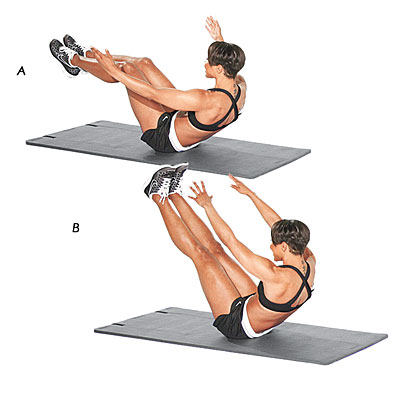
Uses fast-twitch muscle fibers (the ones that contract during high-intensity moves and help improve muscle tone) 

Sit with knees bent and feet on floor. Clasp underside of thighs with both hands, hinge back, and lift feet until lower legs are parallel to floor; release hands. Straighten legs and reach for your toes; hold for 8 breaths. Repeat 3 times.

plank-pelvis-tuck

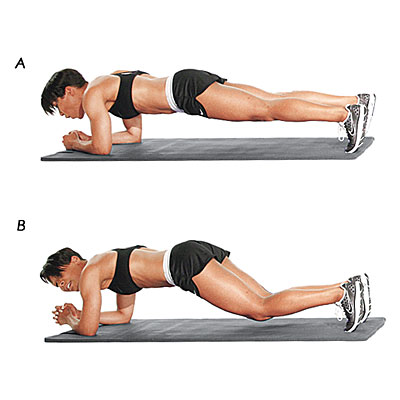
Tones rectus abdominus (six-pack) and transverse abdominus (waist-cinching corset muscles)

Lie facedown with legs extended, elbows bent, feet hip-width apart, elbows shoulder-width apart. Contract abs, then tuck toes to lift body, elbows directly under shoulders. Hold for 4 breaths. Bend knees (do not touch ground), tilt pelvis up; hold for 4 breaths. Keeping abs tight, straighten legs, hold for 4 breaths. Repeat 3 times.

navel-to-spine-pulse
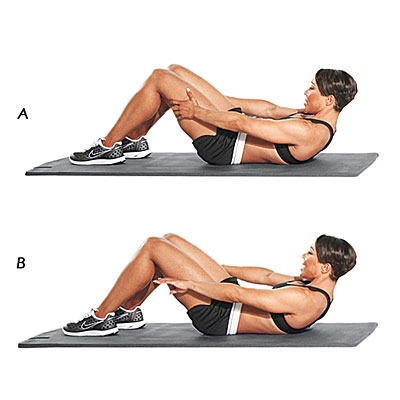
Targets six-pack

Lie faceup with knees bent and feet on floor. Lift shoulders and clasp underside of thighs with both hands; contract abs. Tilt pelvis up, let go of thighs, and reach forward; pulse 20 times. Return to start; reach hands to outside of right thigh and do move with torso turned to right; pulse 20 times. Repeat on left side. This is 1 set. Do 2 sets.


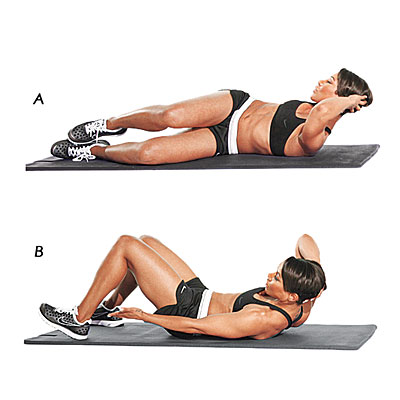
Hits obliques (sides of abs), seratus anterior (muscles below chest), and six-pack

Lie faceup, knees bent to 90 degrees, hands behind head. Lower knees to left and crunch up; do 15--25 reps. Return to start, lift shoulders, extend left arm, and pulse forward for 15--25 reps. Repeat sequence on right side. This is 1 set. Do 2 sets.


Targets corset and six-pack

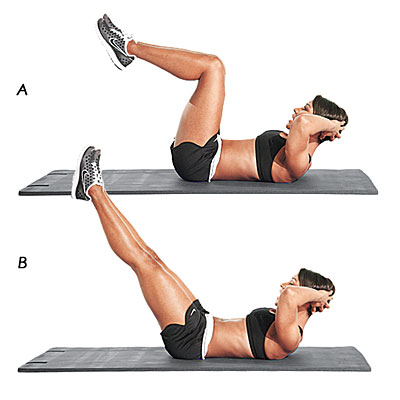
Lie faceup with knees bent to 90 degrees, hands behind head, and abs contracted. Keeping knees stacked over hips, lift shoulders and crunch up; inhale and hold for 3-5 seconds. Exhale and extend legs to 45 degrees; hold for 3-5 seconds while squeezing lower belly. Do 2 sets of 10-15 reps.
Sweat it out for 30-40 minutes with one of these cardio options (or switch them up!) four times a week.

Ratchet up your ride
Go bicycling and include 3-5 30-second sprints (short bursts of full-speed cycling) to tap your core's fast-twitch muscle fibers and boost your calorie burn.

Turn up the treadmill
Walk for 1-15 minutes at a moderate pace (3 to 4.5 mph). Do five 2- minute intervals with incline set at 10-15 percent. Then return to starting incline for 10-15 minutes.


Burn it off in a class
A total-body training class (like kickboxing or Zumba) gives you a major cardio boost and also taps into core strength to tone abs and blast belly fat, Jenkins says.

Play in the pool
Swim laps or practice your paddle-boarding skills. Both of these train the entire body but rely heavily on core muscles to shape and sculpt.