Wednesday, April 30, 2014

There’s No Such Thing As Healthy Obesity, Says Study

http://time.com/82848/theres-no-such-thing-as-healthy-obesity-says-study/
 @acsifferlin

142457659
Getty Images

New research pokes holes in the idea that there's such thing 

as healthy obesity


There’s a persistent and controversial question dividing researchers: Can you can be very overweight and also very healthy? The research suggesting people can be healthy at any size was intriguing, and we covered it. But the tide (and the research that supports it) is turning, with many researchers saying it’s simply not possible to be fit and obese.

Today, a new study published in the Journal of the American College of Cardiology that looked at 14,828 metabolically healthy Korean adults with no known heart disease found obese people had a higher prevalence of early plaque buildup in the arteries compared to normal weight people. The researchers defined obesity in the study as a BMI over 25; in the U.S. obesity is defined as a BMI over 35. The researchers conclude that even though these people may not have heart-related disease yet, their weight is still taking its toll on their health.

“Obese individuals who are considered ‘healthy’ because they don’t currently have heart disease risk factors, should not be assumed healthy by their doctors,” said study author Dr. Yoosoo Chang, MD, a professor at Kangbuk Samsung Hospital Total Healthcare Center Center for Cohort Studies in Seoul, Korea in a statement.

In a corresponding editorial, Dr. Rishi Puri, who runs Cleveland Clinic’s Atherosclerosis Imaging Core Lab, highlights the work of both Chang and Kramer, saying their research has shown that obesity is indeed a real disease. He also questions the necessity of determining whether some obese people can be classified as “metabolically healthy.” “Given our current lack of a ‘cure’ or efficient means of successfully treating obesity over the longer term, might the resources spent on trying to define and justify the existence of a ‘metabolically healthy’ obese population be more wisely allocated to elucidating ways to prevent or treat obesity?” he writes.

The idea that there is “metabolically healthy obesity” has been out there for some time, with one of the more recent studies suggesting that some overweight or obese individuals can be as healthy as their normal-weight peers because they had normal blood pressure, no diabetes and pretty stable cholesterol. One study even found that overweight individuals tended to live longer than normal weight people.

Researchers at Mount Sinai Hospital in Toronto, however, reviewed studies dating back to the 1950s, and concluded that people cannot be both overweight and healthy. They found that people who had a high body mass index (BMI) but whose cholesterol or blood pressure were normal for example, were still at a higher risk of dying fromheart disease. “This concept of healthy obesity came in the last 10 years,” Dr. Caroline Kramer told TIME when the Sinai research came out. “Some studies report that if you are obese but metabolically healthy, you are protected in a way. We don’t think that that is true. And I don’t think it will come as much of a surprise.”

Part of the discrepancy in the findings could be study design. Some large studies just looked at participants’ weight and whether any adverse events occured, but didn’t look at symptoms for poor metabolic health like blood pressure, or early signs of health problems like plaque build up. Others compared healthy obese people to unhealthy obese people and did not have a proper comparison to normal weight people, Kramer told TIME. Researchers are continuing to try and understand how weight and diseases impact people differently, whether it’s due to genetics or environmental factors.

One thing that all sides agree upon is that when it comes to health, there is significant value in focusing on other factors besides the number on the scale. As TIME reported in March, it’s also possible to be thin and unhealthy, and people can be at risk for the same metabolic problems at any size if they do not take care of themselves. “[These findings] don’t surprise me. I don’t think it changes the fact that our focus should be on health rather than weight,” says Dr. David Katz, founding director of the Yale University Prevention Research Center.”The things we recommend for people to be fit are the very things we are recommending for people to not be fat.”

Katz does agree that we should be paying attention to excess body fat, because depending on the type and where, it can cause disease. He encourages his patients to eat well and exercise and stave off unnecessary and potentially harmful body weight, but recognizes that a little pudge around the edges is likely fine.

“The amount of effort that has to go into losing that last 10 pounds can make life not fun. In that situation, I tell my patients that the whole point of being healthy is to have a good life,” says Katz. “If you are working so hard to lose these ten pounds and it’s going to ruin your quality of life, it’s not worth it.”

Wednesday, April 23, 2014

Not Vaccinating Children Is Deadly. This Infographic Proves It

http://www.huffingtonpost.com/2014/04/22/vaccines-for-children-unicef-infographic_n_5192839.html
by  Robbie Couch

Vaccines save lives.

April 24-30 marks the World Health Organization's World Immunization Week, which focuses on global efforts to protect children from deadly but preventable diseases, such as measles.
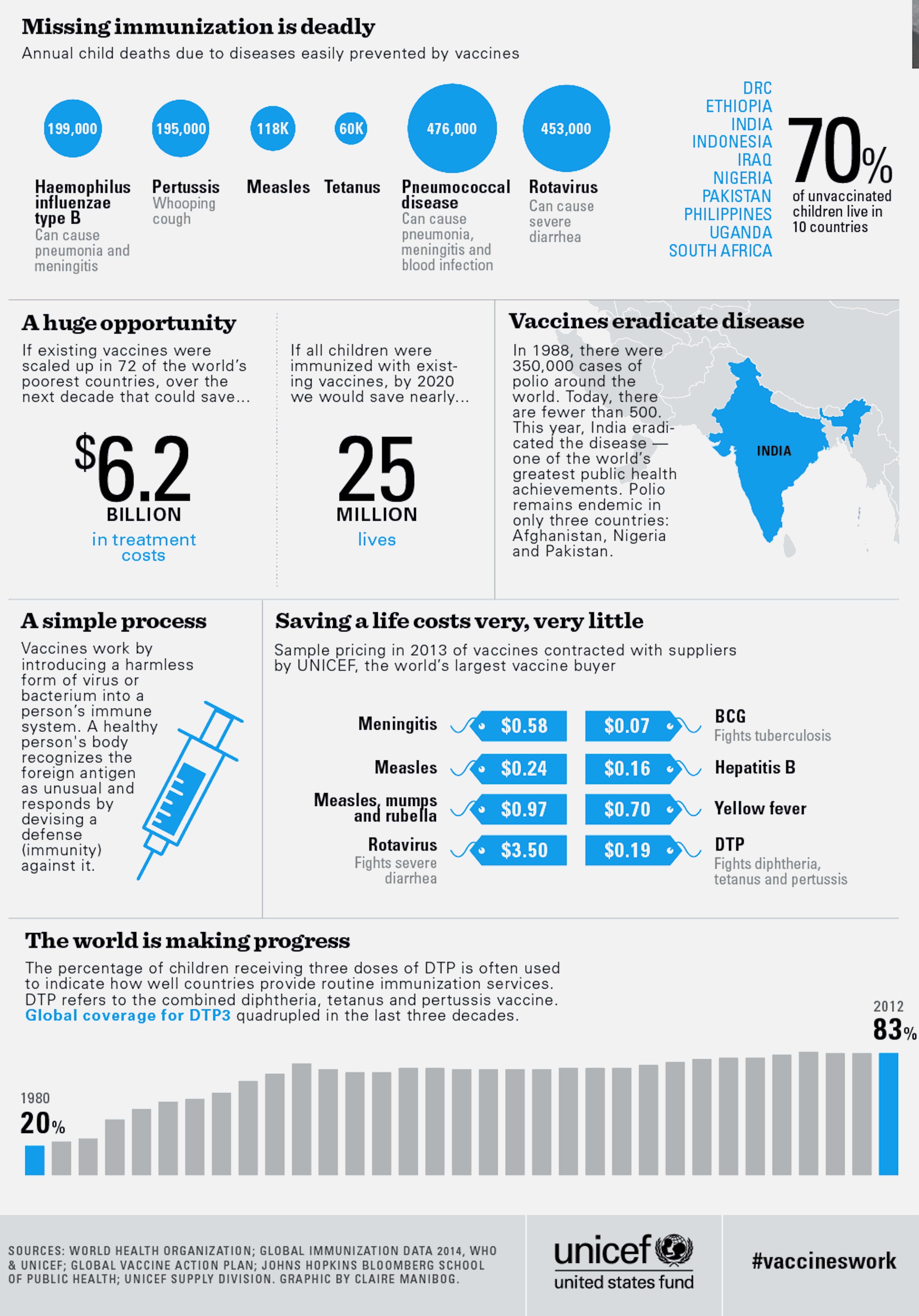
As the infographic below created by UNICEF points out, if all children globally were immunized today, about 25 million lives would be saved by 2020. Vaccines also cost little, and would save billions of dollars in treatment expenses for preventable diseases down the road.
unicef stats

Hepatitis B

Your newborn should get this shot even before leaving the hospital, and receive another dose at one to two months and a third at six to 18 months. The vaccine protects against an incurable, liver-infecting virus, hepatitis B, which can be passed to a baby during childbirth if the mother is infected.

This virus spreads through contact with blood or other body fluids (sharing toothbrushes and utensils can put you at risk).

Soreness at the site of the shot, or a slight fever, is the most common side effect, according to Gabrielle Gold-von Simson, M.D., assistant professor of pediatrics at NYU Langone Medical Center in New York.

DTaP

The DTaP vaccine protects against diphtheria (a germ that can form a gray or black film in the throat), tetanus (an infection that can cause muscle spasms so strong they can break bones), and pertussis (a highly contagious disease that causes a severe, uncontrollable cough, known as whooping cough).

Five vaccine doses are given to children at two months, four months, six months, 15 to 18 months and four to six years. (And boosters at age 11 or 12 and then every 10 years.)

DTaP may be combined with other vaccinations to reduce the number of shots needed. "Now, it's DTaP with hepatitis B and the polio vaccine. 

MMR

This combo shot protects against three viruses: measles (which causes high fever and a body-wide rash); mumps (which causes face pain, swelling of the salivary glands, and sometimes scrotal swelling in boys); and rubella or German measles (which can cause birth defects if the infection occurs during pregnancy).

The first shot is given at 12 to 15 months of age and once again between the ages of four and 
six.

MMR is sometimes combined with the chickenpox vaccine into one shot (brand name ProQuad). "All these different preparations are designed to reduce the amount of shots the pediatrician has to give," says Dr. Gold-von Simson.

Chickenpox

Chickenpox, a highly contagious rash that many people remember from childhood, is caused by the varicella virus. A varicella vaccine was first licensed in 1995 and now spares future generations this itchy misery.

Chickenpox infections can be especially dangerous in adults who don't have immunity from the vaccine or haven't had it in childhood, and can also lead to shingles, an extremely 
painful blistering rash.

The shot is given to children at 12 to 15 months and again between four and six years. The vaccine can cause soreness at the site of the shot, fever, and, in some cases, a mild rash.

Haemophilus Influenza Type B (Hib)

"Haemophilus influenza type b is the bacterium that causes meningitis," says Dr. Gold-von Simson. Meningitis, an inflammation of the membranes surrounding the brain and spinal cord, is particularly dangerous for kids under the age of five.

Hib vaccines are generally given at two, four, six, and 12 to 15 months of age. Depending on the vaccine used, the six-month shot may not be needed. 

Fever, swelling, and redness at the site of the shot are potential side effects.

Polio (IPV)

Polio vaccine is "such a success," says Dr. Gold-von Simson. "Because of the vaccine, there are no more cases (of polio)." 
The virus hasn't been eradicated worldwide, so kids still get the IPV, or inactivated polio vaccine, which is a shot containing killed virus.

Polio is bad news, and can cause paralysis and 
even death. Children are given the IPV at two months, four months, between six to 18 months, and then again between the ages of four and six years.

Pneumococcal Conjugate (PCV)

This vaccine, known as PCV13 (brand name Prevnar), protects against 13 types of Streptococcus pneumoniae, which are bacteria that can cause all sorts of mayhem, including meningitis, pneumonia, ear infections, blood infections, and even death.

A total of four shots are given to kids (at two, four, six, and 12 to 15 months of age) to protect them against the germs, known collectively as 
pneumococcal bacteria.

The most common side effects of the vaccine include drowsiness, swelling at the site of the shot, mild fever, and irritability.

Influenza (flu)

Flu vaccinations are given each year starting in the fall. The Centers for Disease Control and Prevention recommends them for kids ages six months or older, although they aren't required for school attendance. (Connecticut and New Jersey require the vaccine for attending child-care centers and preschool.)

Common side effects from the vaccine include soreness, redness, or swelling at the site of the 
shot. Fever and aches may occur too.

"If you have an egg allergy, you shouldn't have the influenza vaccine," says Dr. Gold-von Simson.

Rotavirus (RV)

The rotavirus vaccine (RV) (brand names RotaTeq, Rotarix) is given to children at two and four months of age. (RotaTeq is also given at six months.) The vaccine protects against a virus that is the most common cause of severe diarrhea and vomiting in young kids worldwide. About 55,000 children in the U.S. were hospitalized each year due to rotavirus before the vaccine was licensed in 2006. 

It is not required for school attendance.

The vaccine is in liquid form and given by mouth to babies. It may make them a bit more irritable and can also cause mild diarrhea or vomiting.

Hepatitis A

Kids can catch hepatitis A from sharing food or drinks or by putting contaminated food or objects in their mouths. It's a viral infection that affects the liver, and can cause a number of symptoms, including fever, tiredness, jaundice, and loss of appetite.

Children ages 12 through 23 months generally get two doses of the Hep A vaccine, with a minimum interval of six months between shots. 
Some states require the vaccine for school attendance.

Soreness where the shot was given, headache, and loss of appetite are the most common side effects of the vaccine.

Meningococcal Conjugate (MCV4)

This vaccine, known as MCV4 (brand name Menactra), protects against meningococcal bacteria, which can infect the membranes surrounding the brain and spinal cord. MCV4 is recommended for kids at 11 or 12 years of age, and anyone between ages two and 55 who is at increased risk of infection (people with certain health conditions, military recruits). 

Teens starting college should be vaccinated  with MCV4 before going to school if they didn't previously get the shot. (Freshman living in dorms are at increased risk of infection.) 

A little pain at the site of the shot is the most common side effect.

Human Papillomavirus (HPV)

Human papillomavirus (HPV) vaccine (brand names Gardasil, Cervarix) is given in three doses over a six-month period, and is approved for girls between ages nine and 26.

While there are over a hundred types of HPV, this vaccine protects against two sexually transmitted types that are the most common causes of cervical cancer. Gardasil also protects against two types that cause genital 
warts and is approved for boys between nine and 26 as well.

The vaccine works only if given before an infection, so doctors recommend it for kids well before they could become sexually active. Although most states don't require HPV vaccination, many are considering mandating it for preteen girls.

Saturday, April 12, 2014

Eight bad habits that can damage your kidneys

http://kidneysymptom.blogspot.com/2012/06/eight-bad-habits-that-can-damage-your.html

In our daily life, some bad habits can damage your kidneys. In case some symptoms such as proteinuria, elevated serum creatinine and swelling occur, kidney damage is already irreversible. With this in mind, we will introduce several major unhealthy habits that may increase the risk of kidney problems, and the goal is to help you better protect the kidneys.

1. Inadequate drinking water

Main functions of the kidneys are to regulate erythrocyte balances and eliminate metabolic wastes in urine. If we do not drink enough water, the blood will be concentrated and renal blood flow is not as strong, helping to eliminate toxins in the blood.

2. Drinking too much beer

For those who have had kidney disease, drinking beer without limitation may cause the deposition of uric acid in renal tubules, causing tubular obstruction and increasing risks of kidney failure.

3. Improer vegetable and fruit consumption

It is commonly accepted that eating lots of fruits and vegetables is good for health. But for those with kidney failure,

4. Eat beverage instead of water

These soft drinks such as soft drinks and cola, coffee or caffeine often rich, a substance that can increase blood pressure and increase the chances of kidney disease.

5. Overeating

It is suggested that protein intake should be 0.8g/kg.d. This means that a person with 50 kg should consume 40g of protein per day. Meat consumption per day should be limited within 300g. Eating too much meat and protein can increase the metabolic load of the kidney. For one suffering from proteinuria, meat consumption too may aggravate protein leakage, worsening renal pathological lesion.

6. Painkiller abuse

Research indicates that using painkillers mixed in a long term may reduce the flow of human blood and greatly affect kidney function. In addition, patients with renal failure induced by pain medication are more likely to suffer from bladder cancer.

Reminder: analgesics may be used occasionally. Those who have used pain relievers through a long-term need to make detailed tests as soon as possible.

7. Heavy sodium in the diet

95% sodium we consume through food is metabolized by the kidneys. Exceeding the salt intake will kidneys work harder and can lead to decreased renal function. Scientific daily salt intake should be controlled within 6g per day.

8. Heavy pressure of life

In society, hypertension as a severe threat to life is largely due to the heavy pressure of life. A common symptom of heavy pressure of life is insomnia. Blood pressure may increase to an average 2-5mg/Hg because of insomnia. Chronic blood pressure can cause damage to kidney capillaries giving rise to kidney problems. Thus, we need to develop a habit of life and good balance between work and the rest to protect the kidneys well and live a healthy life.

The above is of poor lifestyle habits that make you more at risk of kidney disease. For patients with renal impairment, the daily care must be taken very cautiously. If you want personalized assistance, we will gladly help you find the best solution.
http://www.askkidney.com/kidney-disease/122.html


http://positivemed.com/2013/12/01/8-common-habits-may-damage-kidneys/